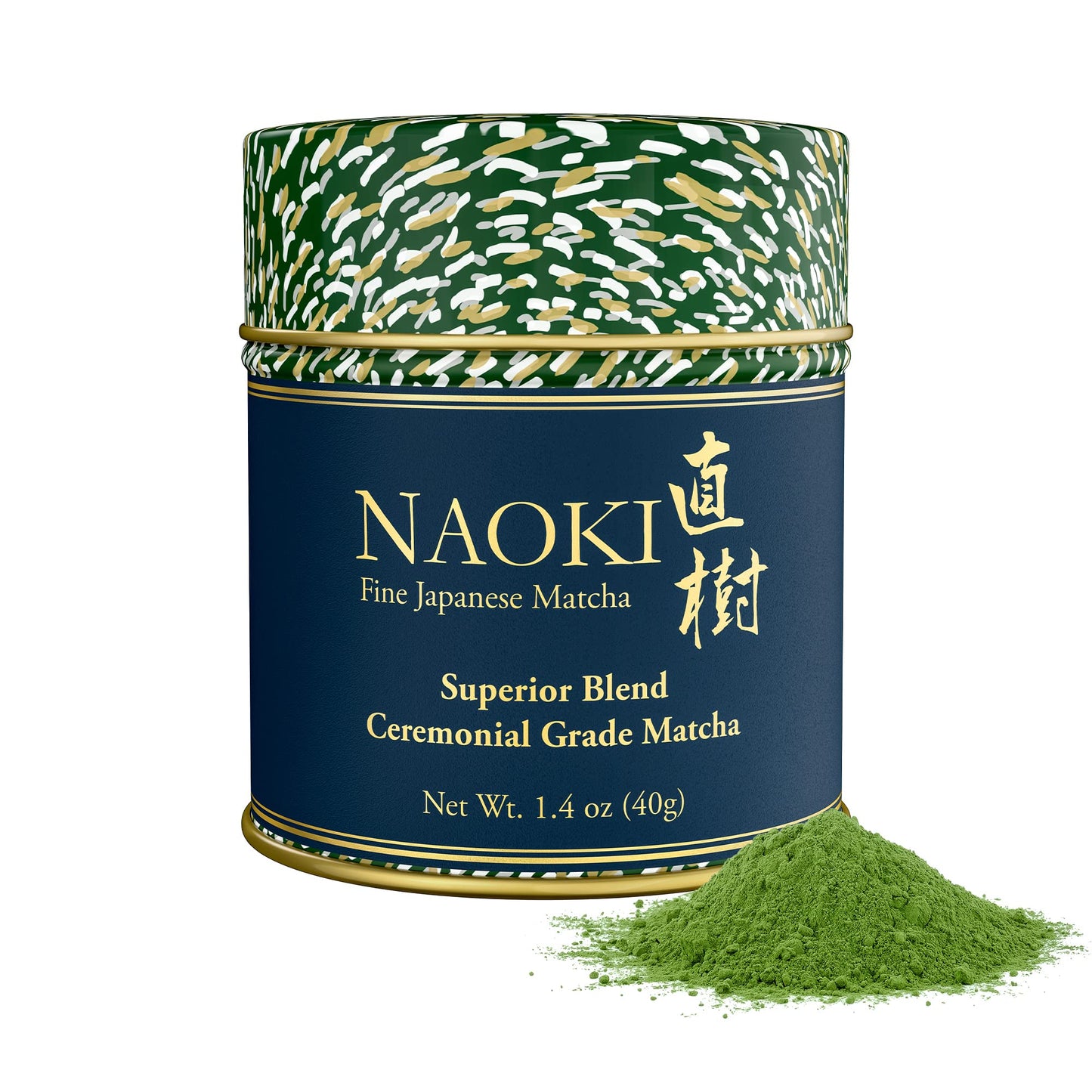
Naoki Matcha Superior Ceremonial Blend – Yoga and Meditation Companion for Centered, Jitter-Free Energy
Naoki Matcha Superior Ceremonial Blend – Yoga and Meditation Companion for Centered, Jitter-Free Energy
Couldn't load pickup availability
Why you'll love it
- L-theanine moderates caffeine to deliver calm focus without the coffee jitters or crash
- Tencha is stone-ground fresh right before shipping from Japan, guaranteeing peak freshness in airtight packaging
- Authentic Uji Kyoto origin with shade-grown first-harvest leaves signals genuine ceremonial-grade quality
- Smooth, balanced umami with a hint of bitterness makes it approachable for first-time ceremonial matcha drinkers
- Versatile preparation (usucha, latte, smoothie, recipes) avoids the 'right way vs. wrong way' intimidation
- Larger 3.5oz/100g format delivers 50 servings at better per-cup value than smaller tins
Perfect for
- Replace morning coffee with a calmer, 6-hour steady-energy matcha latte
- Brew traditional usucha matcha tea for a midday focus reset
- Blend into smoothies and recipes where matcha is the star ingredient
- Gift a premium Japanese tea experience with multiple blend choices
- Use the larger 100g tin for daily ritual consumption over 50 servings


Our collection of matcha from different tea regions of Japan

Here are some tips


Matcha provides a focused, mellow energy boost without jitters or the crash you normally expect from coffee.
This is due to naturally present L-theanine (an amino acid) and caffeine in matcha.
Matcha is also high in antioxidants, with a greater concentration compared to regular green teas.
Understanding matcha
Why do we describe matcha as "blends"?
Matcha is made from shade-grown tea leaves that is milled into a fine powder. The final taste of matcha depends on a tea master who will select different tea leaves for their taste attributes.
The tea master “blends” these leaves together to accentuate certain flavors so that he can achieve a final result that the customer will find enjoyable.


Slow down and unwind with Usucha (traditional Japanese matcha tea)
Enjoy the classic frothy thin tea ("usucha") at home.
Use 1 tsp (2 grams) of matcha along with 3 oz of 170 degree F water.
Best made using a bamboo whisk.
If too you prefer it less strong, use 5 oz of water instead
The best way to make Matcha Latte (hot or iced) every morning
Create the base "matcha shot" with 1.5 tsp (3 grams) of matcha and 1 oz of water.
Mix vigorously until there are no more clumps. Add 6 oz of your favourite milk and add sweetener to taste.
This formula works for both hot and cold matcha lattes
How to make an easy Cold Brew Matcha for better energy
Add 1 tsp (2 grams) of matcha to 6-8 oz of cold water and mix. Adjust the amount of water according to your personal preference.
We easily make cold brew matcha at home and at work using bottles.
All you need to do is add matcha and water to a bottle and shake it up until the matcha is evenly mixed. Try this with coconut water instead of water for a real treat.
Usucha (thin tea)
Matcha Latte
Cold Brew Matcha
Usucha (thin tea)
Matcha Latte
Cold Brew Matcha
Frequently Asked Questions
1. I’m new to matcha. Which blend should I choose? We recommend you to start with either the Organic First Spring Blend or Superior Blend. The Organic First Spring Blend is smooth, low in bitterness with a slight umami.The Superior Blend has a smooth, balanced flavor with moderate umami. Ideal for beginners and daily drinking.Both blends are versatile and excellent for making matcha lattes.
2. Is the bamboo whisk or electric whisk better for making matcha? It really depends on what you prefer. If you’re looking for a beautiful microfoam, the bamboo whisk (chasen) is a great choice. With a little practice, it’s simple to use and gives you more control over frothing and mixing. On the other hand, if convenience is key, an electric whisk is super handy. It works especially well for smaller servings—like mixing about 1 teaspoon of matcha into at least 4 ounces of liquid. Both options have their perks, so you can choose what works best for your matcha-making style!
3. How many servings of matcha latte can I make with 40g/1.4oz of matcha?We define one serving as 2 grams (about 1 teaspoon), but how much matcha you use per drink really depends on your taste and preference. If you’re just starting out, 2 grams is a great amount for a latte—it’s smooth and flavorful without being too strong. With this amount, you’ll get about 20 servings from a tin. For seasoned matcha lovers, you might prefer a bolder flavor by using 4 grams per latte. This will, of course, give you fewer servings per tin, but it’s perfect for those who enjoy a stronger matcha kick.
4. I’m worried about radiation and heavy metals. Do you test for radiation and heavy metals in your matcha? We rigorously test every crop of matcha for potential hazards, including radiation and heavy metals. These tests are essential for our factories to maintain their food safety certifications and licenses, which are required for continued operations. Additionally, the Japanese government conducts its own independent radiation testing on all food products. The results have consistently been negative, and they’re publicly available in English on the Japanese Ministry of Health, Labour and Welfare’s website.
5. What if I don’t like it? We’re here to help! Preparing matcha properly can make all the difference in bringing out its best flavor, and we’re happy to guide you with recipes, tips, and techniques. If your product didn’t meet your expectations, no worries—just reach out to us through the “contact seller” option. To help us resolve your concern quickly, it would be great if you could send us pictures of the product and its batch code. If you can also share how you’ve been preparing your matcha—your recipe and method—we’d be happy to provide personalized advice to help you get the most out of your matcha experience. We’ll do everything we can to ensure you’re satisfied and enjoying every sip!
6. How long can I keep my matcha for? You can store matcha for up to 12 months in an opaque, airtight container from the date it’s ground. Once opened, we recommend enjoying it within 1–2 months for the best flavor. To keep your matcha as fresh as possible, it’s a good idea to store it in the fridge.
7. How fresh are Naoki Matcha’s products? We ship our matcha in small batches to ensure freshness, and our products typically have at least 6–9 months of shelf life remaining. Amazon handles delivery using the “First-In-First-Out” method to keep things as fresh as possible. That said, occasional mishaps can happen. If you receive a product with less-than-ideal shelf life or a damaged bag due to delivery issues, don’t worry—just reach out to us! After a quick review, we’ll be happy to provide a replacement and make things right.
8. What does “ceremonial-grade” really mean? “Ceremonial-grade” doesn’t have a regulated definition, but for us, it means matcha that’s high-quality enough to enjoy on its own. Save for our “All Purpose Culinary Grade Matcha”, we would consider our entire lineup to meet our criteria for “ceremonial grade”. When it comes to matcha, the price usually reflects the quality. Higher-grade matcha typically has a smoother mouthfeel, less bitterness, and more umami, which is why it’s priced higher. It’s all about finding the right balance between taste and budget for your matcha journey!


Great-tasting matcha from Japan
We offer matcha and tea from the best tea regions all over Japan. Direct from farms and tea manufacturers.
A focus on quality and flavor
Our mission is to help you enjoy matcha. We have 7 different kinds of matcha for you to choose from.

What problem are we solving?
Not all matcha is equal. It is tough to separate good matcha from the overpriced and mediocre. We work hard to offer the best quality product at each price point.
Why do we love what we do?
For something so simple, matcha can have a huge range of flavors ranging from sweet, nutty to savory and complex. Depending on the available tea leaves and growing techniques, there are so many possibilities!
How did we get our start?
We started with just 1 type of matcha. We now work direct with a network of tea growers and manufacturers in Japan, offering 7 kinds of matcha.


Shop Naoki Matcha
Visit the Store
Product Information
Naoki Matcha – Authentic Japanese First Harvest Ceremonial Grade Matcha Green Tea Powder from Uji, Kyoto (100g / 3.5oz)
✓ Our Superior Blend Ceremonial Grade Matcha in Larger Packaging - Bigger packaging that offers both convenience and even greater value! Our 3.5 oz / 100g package serves a total of 50 servings. 1 tsp (2 grams) of matcha powder makes either a cup of matcha tea (usucha) or a small of matcha latte.
✓ Premium Japanese Ceremonial Grade Matcha, Fresh from Japan - Made from shade grown, First Harvest tea leaves from Uji Kyoto. The tencha is only ground into powder right before it leaves Japan for the USA, and then sealed into air-tight packets. This gets you extremely fresh, quality Uji matcha to be enjoyed right here in America.
✓ Smooth, Balanced And Versatile, Ideal For Matcha Beginners - This matcha ceremonial grade green tea powder is smooth with balanced umami with a hint of bitterness. It is the perfect matcha for beginners looking to make matcha lattes or occasional matcha teas (usucha).We recommend using this for recipes where matcha is the main ingredient.
✓ Improve Your Focus, Boost Energy Without Coffee – Greatly increase your focus by drinking Naoki Matcha. Unlike the typical caffeine rush from coffee, the amino acid L-theanine in Naoki Matcha moderates the effects of caffeine and helps to relax the mind and body while providing a steady boost of energy for up to 6 hours. Matcha is also naturally gluten and sugar free, and is a healthy source of antioxidants.
✓ We Want To Help You Enjoy Matcha – To ensure you have the best matcha experience, we provide our full guidance through directions for use, recipes and tips for enjoying it. Whether you like to drink matcha as a tea, or to mix it up as a latte or smoothie, we do not think there’s a right or wrong way to enjoy matcha. Our 3.5 oz / 100g tin serves a total of 50 servings. 1 tsp (2 grams) of matcha powder makes either a cup of matcha tea (usucha) or a small matcha latte.
Ingredients
Matcha Powder
Items Details
Item Form: Powder
Tea Variety: Matcha
Diet Type: Gluten Free
Number of Items: 1
Container Type: Can
Specialty: Sugar Free
Recommended Uses For Product: Relaxation
Region of Origin: JP
Allergen Information: Gluten Free
Special Ingredients: Shade-grown tea leaves, First harvest tea leaves
Product Shelf Life: 365 Days
Caffeine Content Description: Low Caffeine
Part Number: EL-68RD-SPOS
Sweetness Description: Not Sweet
Frequently Asked Questions
How does Naoki Superior fit into a daily mindfulness or self-care routine?
Most wellness drinkers brew it as part of a morning ritual: heat water, sift, whisk, sip. The slow preparation mirrors the same breathing patterns used in meditation and yoga, turning your first drink of the day into a centering moment rather than a caffeine grab.
Is this matcha actually high in antioxidants the way ceremonial-grade claims suggest?
Yes. Shade-grown first-harvest tencha from Uji is naturally rich in catechins, particularly EGCG. Naoki's stone-grinding process preserves these compounds because the powder is sealed and shipped fresh, which matters more than a label claim.
Is the ingredient list clean enough for a clean-eating or whole-food lifestyle?
It is a single-ingredient product: 100% Japanese matcha green tea powder. It is naturally gluten-free, sugar-free, and contains no additives, fillers, or sweeteners, which fits cleanly into whole-food, paleo, and clean-label routines.
Can I use this in my evening wind-down routine, or is it too stimulating?
For a true wind-down, we suggest a decaf herbal tea instead. Matcha is best enjoyed earlier in the day, but its L-theanine content does produce a calm, alert focus that some drinkers prefer over coffee even in the late morning.
Will this help me cut back on coffee as part of a health reset?
It is one of the most popular coffee-alternative options for wellness resets because the L-theanine softens caffeine's edge. Most drinkers successfully replace one or two daily coffees within the first week and notice steadier energy and better sleep within a month.
Is ceremonial-grade matcha worth the upgrade from culinary grade for a wellness drinker?
For a daily ritual, yes. Ceremonial grade is smoother, more umami, and lower in bitterness, which means you actually enjoy drinking it daily. Culinary grade is designed to be hidden in recipes, not sipped on its own.
How does this compare to a greens superfood powder for antioxidant benefits?
Matcha is one of the most antioxidant-dense single-ingredient foods available, with a unique catechin profile you will not get from a generic greens blend. It also delivers calm, focused energy, which a greens powder typically does not.
Is this matcha smoother and less bitter than other ceremonial grades I have tried?
Most first-time ceremonial drinkers find Naoki Superior smoother and more balanced than competing ceremonial blends. The first-harvest Uji tencha and careful stone-grinding produce a cleaner umami with only a gentle, pleasant bitterness.
Is ceremonial-grade matcha actually ceremonial, or is that just a marketing term?
True ceremonial-grade matcha is grown, harvested, and processed to traditional Japanese standards fit for tea ceremony. Naoki Superior is sourced from Uji, Kyoto, the most respected matcha region in Japan, and is stone-ground from first-harvest tencha, meeting the real criteria behind the term.
Will drinking matcha every day be too much caffeine for a health-conscious person?
One serving of Naoki contains roughly 30-40mg of caffeine, less than a typical cup of coffee. With L-theanine moderating absorption, most wellness drinkers tolerate daily matcha comfortably and find it a net positive for energy and focus.
Is this safe to drink during pregnancy or while breastfeeding?
Matcha contains caffeine, so we recommend consulting your healthcare provider for personalized guidance. Many pregnant women choose to limit or avoid caffeine, and matcha is no exception to that conversation.
I'm sensitive to caffeine but want the focus benefits. Is this still a good choice?
It depends on your sensitivity level. Because the caffeine is moderated by L-theanine, many mildly sensitive drinkers tolerate matcha better than coffee, but if you have been advised to avoid caffeine entirely, this is not the right product for you.
Is 100g too much for one person, or is the bigger tin actually a better wellness value?
For a committed daily ritual, 100g is the better value. It yields about 50 servings, locks in freshness with a single purchase, and the airtight tin keeps the powder vibrant until your last scoop.
How do I prepare traditional usucha (thin matcha tea) at home?
Sift 1-2 scoops of Naoki matcha into a bowl, add about 70ml of hot water just below boiling (around 175°F / 80°C), and whisk in a rapid W or M motion with a bamboo chasen until the surface is frothy. Drink directly from the bowl.
What's the best way to make a matcha latte?
Sift 1-2 scoops into a cup, whisk with a small splash of warm water until smooth, then top with steamed or frothed milk of your choice. Sweeten to taste with honey, maple, or simple syrup.
Can I use this matcha in smoothies, baking, and recipes?
Yes. For smoothies, blend a scoop with your fruits and a liquid base. For baking, use the Organic Culinary grade for recipes where matcha is folded into batters, since it is designed to stand up to heat and other strong flavors. Superior works well in no-bake recipes, energy balls, and whipped cream.
Do I need any special equipment to brew matcha, or will my regular kettle work?
You only need hot water, a scoop, a bowl, and a whisk. A bamboo chasen and a fine sieve produce the best traditional result, but a small kitchen whisk or an electric milk frother also works well for everyday preparation.
Does this matcha work with a chasen, frother, or electric whisk?
Yes. It is fully compatible with traditional bamboo whisks, handheld milk frothers, and electric matcha whisks. Use a fine mesh sifter first to break up any clumps for the smoothest cup.
What comes in the box, and what do I need to buy separately?
Your order arrives as a sealed airtight tin of stone-ground matcha powder. Bowls, whisks, sifters, and milk frothers are not included and can be added separately, but they are not required to enjoy the matcha.
How should I store the matcha after opening, and how long will it stay fresh?
Keep the tin tightly sealed, stored in a cool, dark place away from direct sunlight, heat, and humidity. For longest freshness, refrigerate after opening. Consumed within 4-6 weeks of opening, the color and flavor are at their peak, though properly stored matcha remains enjoyable for longer.
Is this matcha safe for people with allergies or dietary restrictions?
Naoki matcha is a single-ingredient product, naturally gluten-free, sugar-free, vegan, and contains no nuts, dairy, soy, or additives. It is produced in Japan in facilities that handle only tea. Always check the label if you have specific allergen concerns.
What's the difference between matcha and regular green tea?
Matcha is shade-grown, stone-ground whole tea leaf, so you consume the entire leaf rather than steeping and discarding it. This delivers a far higher concentration of antioxidants, L-theanine, and caffeine per serving, plus a richer umami flavor and a frothy, ceremonial texture.
What's the difference between ceremonial grade and culinary grade matcha?
Ceremonial grade is made from the youngest first-harvest shade-grown leaves and is smooth, sweet, and umami-forward, designed to be whisked and sipped on its own. Culinary grade uses older leaves, has a stronger, more bitter profile, and is designed to be mixed into lattes, baked goods, and recipes where it is not the only flavor.